The 10-Second Test: What Your Sit-to-Stand Says About Your Future Health
DAILY HABITS
May 31, 2026
As a physiotherapist, I'm always looking for simple movements that reveal a lot about a person's overall health. Surprisingly, one of the most powerful assessments doesn't require expensive equipment, fitness trackers or a laboratory. It simply involves getting up from a chair.
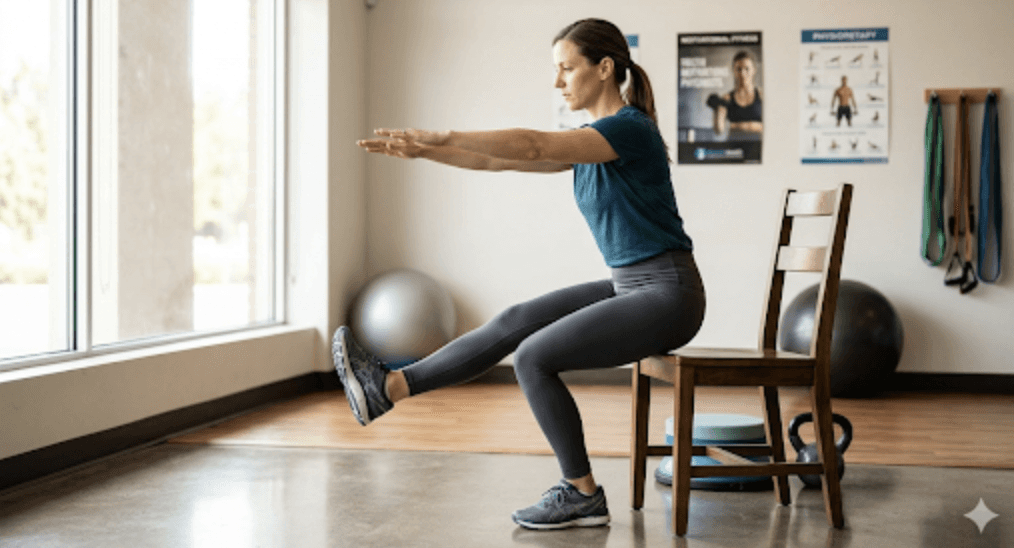
The Single-Leg Sit-to-Stand (SLSTS) is often considered one of the most valuable indicators of functional strength, mobility and longevity. In many ways, it acts as a snapshot of how well your body is aging.
I frequently prescribe this exercise—along with modified assisted versions—to clients of all ages because it provides valuable information about strength, balance, coordination and joint health, while simultaneously improving all of them.
So what exactly does this simple movement tell us about our future health?
It Reveals Hidden Weaknesses Before They Become Problems
Most of us naturally favour one side of our body without realising it.
In a regular squat or when standing from a chair using both legs, the stronger side often compensates for the weaker side. This can hide significant imbalances for years.
Over time, these movement asymmetries can contribute to joint wear, muscle weakness and reduced efficiency in everyday movement.
The Single-Leg Sit-to-Stand removes the ability to compensate. Each leg must perform independently, revealing weaknesses that may otherwise go unnoticed. Identifying and addressing these deficits early can help protect joints and improve movement quality for years to come.
It Tests Your Hip and Knee Stability
The movement demands strong activation from key stabilising muscles, particularly the Gluteus Medius and the Vastus Medialis Oblique (VMO).
Without support from the opposite leg, the body must work hard to prevent the pelvis from dropping and the knee from collapsing inward.
These stabilising muscles play a critical role in maintaining healthy movement patterns. When they function well, they help distribute forces efficiently through the body. When they are weak, excessive stress can be placed on the knees, hips and lower back.
The ability to perform a controlled Single-Leg Sit-to-Stand often reflects the quality of these stabilising systems.
It May Predict Your Risk of Falling
Falls remain one of the leading causes of injury and loss of independence as we age.
Contrary to popular belief, balance isn't simply the ability to stand still. Real-world balance requires the ability to control your body while moving, changing direction and recovering from unexpected challenges.
The Single-Leg Sit-to-Stand develops and assesses this type of dynamic balance. It requires the body to control its centre of mass over a narrow base of support while simultaneously producing and absorbing force.
Importantly, it also develops eccentric strength—your body's braking system—which is essential when sitting down, navigating stairs or recovering from a trip.
It Supports Bone and Metabolic Health
One of the reasons strength training is so important as we age is that our bones respond to mechanical load.
According to Wolff's Law, bone tissue adapts to the stresses placed upon it. The greater the appropriate loading stimulus, the stronger the bone becomes.
Because the Single-Leg Sit-to-Stand places your body weight through a single limb, it creates significant loading through the hip and femur. These are areas commonly affected by osteoporosis and fracture risk later in life.
At the same time, the exercise recruits large muscle groups, supporting muscle mass, metabolic health and healthy aging.
It Reflects Functional Independence
Perhaps most importantly, the ability to rise from a chair without assistance is closely linked to independence.
Getting out of a car, standing from the couch, rising from a toilet and recovering from the ground all rely on similar movement patterns.
The Single-Leg Sit-to-Stand measures what physiotherapists call relative strength—how strong you are compared to your body weight.
Research consistently shows that maintaining this type of functional strength is strongly associated with better mobility, quality of life and long-term health outcomes.
Can You Pass the Test?
Using a sturdy chair, sit near the front edge and extend one leg forward. Without using your hands, see if you can stand up under control and then slowly return to sitting.
Don't worry if you can't do it immediately.
For many people, especially those recovering from injury, managing pain or rebuilding strength, this movement requires practice and progression.
Start by using a higher chair, lightly assisting with your hands, or focusing on the lowering phase first. As your strength improves, you'll gradually build the capacity needed for the full movement.
What matters most isn't perfection—it's paying attention to what the movement is telling you.
Because sometimes a simple 10-second test can reveal more about your future health than you might expect.
Namaste,
Lisa